
A child's myopia prescription that climbs every year is not simply an inconvenience. Higher lifetime myopia is directly associated with increased risk of retinal detachment, glaucoma, and macular degeneration. MiSight 1 day is the first and only FDA-approved soft contact lens specifically designed to slow myopia progression in children. Dr. Malani fits MiSight at Lotus Eyecare for Frisco children ages 8 to 12, giving parents a clinically proven, daily-wear option to address myopia now, before it compounds into something harder to manage later.
MiSight 1 Day: FDA-Approved Myopia Control for Children in Frisco


How MiSight 1 day slows myopia progression
MiSight uses CooperVision's ActivControl Technology. Each lens contains a central zone that corrects your child's distance prescription, allowing clear vision for school, reading, and sports. Surrounding that central zone are concentric treatment rings that bring peripheral light to focus slightly in front of the retina. That peripheral defocus is the signal that tells the eye to slow its axial elongation, the actual structural change driving worsening myopia.
In the three-year pivotal clinical trial submitted for FDA approval, children wearing MiSight experienced 59% less myopia progression on average compared with children in standard single-vision lenses. The treatment effect is ongoing: your child sees clearly through the lens all day without ever sensing the treatment zones working. The goal is not just a stable prescription this year. It is a lower final prescription and a meaningfully reduced risk of serious eye disease over a lifetime.
Which children are candidates for MiSight
- Children ages 8 to 12 who have been diagnosed with myopia, the FDA-approved age range for starting the treatment
- Kids whose prescription has increased in two or more consecutive years, the group with the highest risk of continued progression
- Children who are ready for contact lenses, most kids in this age range learn insertion and removal within a week with some parental support at home
- Active children who find glasses inconvenient during sports and activities
- Families who want an FDA-approved treatment backed by a multi-year published clinical trial
- Kids who prefer a fresh daily lens with no cleaning, no case, and no overnight storage
- Children already in glasses who want the option of clear daytime vision without frames
- Patients whose siblings or parents have high myopia, a meaningful risk factor for progression
Daily wear and progression tracking at Lotus Eyecare
Your child inserts a fresh lens pair each morning and discards both lenses at bedtime. There is no cleaning step and no storage case. Because the lenses are never reused, hygiene is simpler than with any reusable lens type. Dr. Malani tracks both axial length and refraction at each follow-up visit so we have objective data on whether progression is slowing as expected.
Single-use daily wear
Every morning your child opens a fresh blister pack, fills the lens with a drop of rewetting solution, inserts it, and is ready for the day. At bedtime, both lenses are discarded. No cleaning step, no solution, no case to keep track of. Because the lens is never reused, there is no protein or deposit buildup. Most children in Frisco learn insertion and removal at their first or second fitting visit with Dr. Malani's guidance.

Axial length and refraction tracking
Dr. Malani measures both axial length (the physical length of the eyeball) and refraction at each scheduled visit. Axial length is the most reliable indicator of whether myopia is progressing or slowing, because it reflects the actual structural change in the eye, not just the lens power needed to correct it. If measurements show progression accelerating despite MiSight, we can adjust the management plan, for example by adding low-dose atropine as a complementary therapy.
Other services for kids at Lotus Eyecare
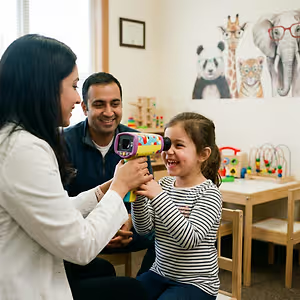
The full menu of myopia control options including Ortho-K, MiSight, and atropine.
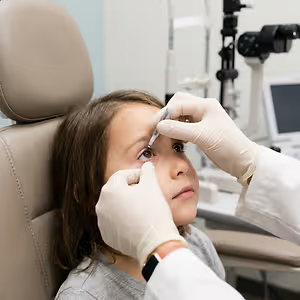

The annual exam that catches what school screenings miss and tracks myopia precisely.
Slowing myopia now reduces the risk of serious eye disease later.
The earlier progression is addressed, the lower your child's final prescription is likely to be. Book a MiSight consultation at Lotus Eyecare in Frisco and find out whether your child is a candidate.
MiSight questions from Frisco parents
MiSight is FDA-approved for children ages 8 to 12 at the start of treatment. Most children in that range can learn insertion and removal within a week of practice at home. Once started, your child can continue wearing MiSight past age 12 to maintain the myopia control benefit through the years when progression is most active.
No. The central optical zone of the lens delivers your child's distance correction clearly and naturally. The peripheral treatment rings are not perceptible during wear. Most children adapt within the first day or two and report no difference from a standard soft contact lens in terms of comfort and vision quality.
MiSight is a soft daily lens worn during the day and removed at bedtime. Ortho-K is a rigid lens worn only during sleep that reshapes the cornea, allowing your child to go lens-free during the day. Both options slow myopia progression through similar mechanisms. Dr. Malani recommends the option that best fits your child's age, prescription, daily schedule, and comfort with handling different lens types.
Yes. MiSight pricing includes the myopia management fitting evaluation, the lenses themselves, and the scheduled tracking visits that monitor axial length and refraction. Most vision insurance plans do not cover myopia control as a distinct benefit, but HSA and FSA accounts typically cover the treatment. Dr. Malani provides a written cost breakdown at the consultation so the full investment is clear before you commit.
That is common at age 8 or 9 and not a barrier to starting treatment. Dr. Malani can begin with low-dose atropine eye drops applied at bedtime, which slows axial elongation without requiring lens handling at all. When your child is ready to transition to MiSight, the switch is straightforward. The right starting point depends on your child's readiness and the rate of progression, which is assessed at the consultation.