
Glaucoma does not announce itself. There is no pain, no blurring, no warning sign until the peripheral vision has already been narrowed. By the time a patient notices something is wrong, a significant portion of the optic nerve is gone, and that loss is permanent. The only way to protect your vision from glaucoma is to find it before symptoms begin. Dr. Malani at Lotus Eyecare is a glaucoma specialist. Her focus is detection early enough to keep the damage from reaching the threshold you would actually feel.
Protecting Your Vision From Glaucoma in Frisco, Texas
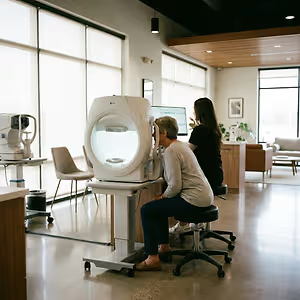

The Mechanism: Why Glaucoma Causes Irreversible Damage Before You Notice It
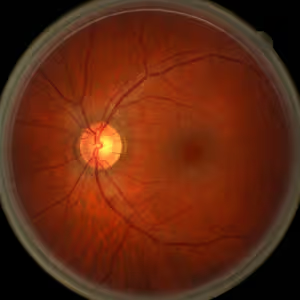
Glaucoma damages the optic nerve, most often because the pressure inside the eye exceeds what that particular nerve can tolerate. The nerve fibers thin gradually, starting at the edges of your visual field. The brain compensates by filling in the blank areas, so most people do not register the loss until a large portion of peripheral vision is gone.
That same mechanism is what makes early detection so consequential. The damage is permanent, but the rate of damage is controllable. A patient caught in the early stage and kept on appropriate treatment can maintain functional vision for life. The patients who lose significant sight to glaucoma are almost always those diagnosed after the damage was already advanced.
Risk Factors That Warrant Earlier and More Frequent Screening
- Parent or sibling diagnosed with glaucoma
- Age over 60, or over 40 for patients of African descent
- Diabetes or elevated blood pressure
- Elevated eye pressure or thin corneas flagged at a prior exam
- Long-term corticosteroid use, including inhalers and nasal sprays
- Prior serious eye injury
- High myopia or high hyperopia
- Previously identified as a glaucoma suspect at another office
The Diagnostic Process Dr. Malani Uses to Detect Glaucoma Early
A pressure reading alone catches fewer than half of glaucoma cases. At Lotus Eyecare, the evaluation uses four measurements in combination: OCT imaging of the optic nerve fiber layer, visual field testing mapped against age-matched norms, corneal thickness measurement (pachymetry), and intraocular pressure taken with multiple methods. Together these four tests detect structural and functional damage at the stage before any field loss is visible to the patient. That is the window where treatment is most effective.
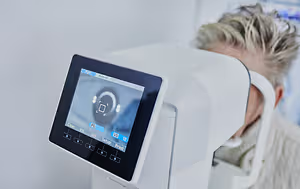
OCT imaging maps the thickness of the optic nerve fiber layer, detecting thinning before visual field loss begins. Visual field testing quantifies peripheral vision against age-matched norms and tracks change over time. Together they catch glaucoma years earlier than a pressure measurement alone, and they create a documented baseline for monitoring progression.
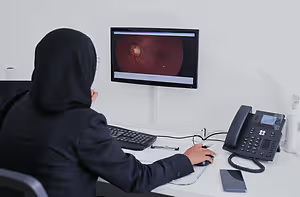
Most glaucoma is managed with pressure-lowering eye drops. When drops are not the right fit for a patient, Dr. Malani coordinates with glaucoma surgeons for SLT laser or minimally invasive glaucoma surgery (MIGS). She manages the pre- and post-operative care and runs all follow-up monitoring. Treatment plans are matched to the individual, not defaulted to a standard protocol.
What a Glaucoma Evaluation at Lotus Eyecare Includes
The evaluation is structured to give Dr. Malani a complete picture, not just a pressure number. The visit covers:
- Intraocular pressure measured by multiple methods.
- OCT imaging of the optic nerve and retinal nerve fiber layer.
- Visual field testing compared to age-matched norms.
- Pachymetry to measure corneal thickness.
- Detailed family history and medication review.
- Review of any prior glaucoma evaluations or imaging.
At the end of the visit, Dr. Malani gives you a clear verdict: not at risk, glaucoma suspect, or active glaucoma. If treatment is needed, it starts the same day. If monitoring is the right approach, she explains exactly what she is watching and why.
Other Medical Eye Care at Lotus Eyecare

Glaucoma Questions Frisco Patients Ask Dr. Malani
Yes. It is called normal-tension glaucoma. The pressure reading sits in the normal range but the optic nerve is still being damaged. OCT and visual field testing catch this. A pressure check alone misses it.
Almost never if it is caught early and treated. The vision lost before diagnosis does not come back, but treatment slows or stops further loss for most patients. The patients who go blind from glaucoma are usually the ones who never got diagnosed or stopped using their drops.
Three to four visits a year for active glaucoma, more often when treatment changes. Glaucoma suspects come in twice a year for OCT and visual field comparison. Stable patients on a steady regimen can sometimes stretch to every six months.
For most patients on drops, yes. SLT laser and MIGS procedures can reduce or eliminate drop dependence for the right candidates. Dr. Malani goes over which option fits at the evaluation.
Yes. Glaucoma evaluations, OCT, visual field testing, and ongoing management bill to medical insurance, not vision insurance. We verify your benefits before any imaging or testing.
Protect the Vision You Have.
Glaucoma caught before symptoms begin is glaucoma that does not define your vision. Schedule an evaluation with Dr. Malani at Lotus Eyecare in Frisco.