
A child can pass every vision screening and still struggle to read, copy from the board, or follow a moving target in sports. The problem is not visual acuity. The two eyes are not working as a coordinated pair, and that gap shows up in the classroom and on the field long before anyone identifies it as a visual problem. At Lotus Eyecare, Dr. Malani evaluates and treats binocular vision dysfunction through a structured, individualized vision therapy program for children and adults in Frisco.
Vision Therapy in Frisco, Texas

The conditions vision therapy addresses
Vision therapy treats disorders of binocular coordination, not refractive error. A new prescription will not fix how the two eyes aim, sustain focus, or track together. The most common conditions we work with include:
- Convergence insufficiency: the eyes cannot pull inward and hold position for near work, causing words to blur or double during reading
- Amblyopia: one eye has not developed full acuity and the brain has learned to suppress it
- Strabismus: one eye consistently turns in, out, up, or down
- Accommodative dysfunction: the focusing system is inconsistent, making sustained near work tiring
- Oculomotor dysfunction: the eyes do not track a moving target or a line of text without losing their place
- Visual processing deficits: what the eyes see does not translate efficiently into reading or motor response
Adults with post-concussion vision symptoms or persistent digital eye strain are also candidates. There is no upper age limit for vision therapy because the brain continues to adapt throughout life.
Signs your child may have a binocular vision problem
- Skips lines, re-reads, or loses place frequently while reading
- Headaches or tired, aching eyes after short reading sessions
- Words appear to move, float, or double on the page
- Covers or closes one eye during near work or screen time
- Reading comprehension lags significantly behind verbal ability and listening comprehension
- Avoids reading even when the subject is genuinely interesting
- Trouble tracking a ball or catching, despite otherwise good coordination
- Tutoring helps temporarily but the underlying difficulty does not resolve
How the program works at Lotus Eyecare
Vision therapy at Lotus Eyecare is built on a binocular vision evaluation that identifies precisely which visual skill is breaking down and by how much. The program has two components that work together: supervised in-office sessions and a structured home practice routine.
Progress is measured at every visit. Dr. Malani adjusts the activities as the visual system strengthens so the program never plateaus. Most patients reach discharge criteria within 20 to 40 weekly sessions depending on diagnosis and how consistently the home work is done.
In-office sessions
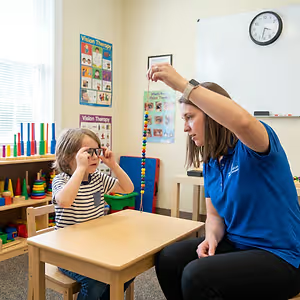
Each session is one-on-one and structured around the patient's specific deficit. Activities include prism lenses, Brock strings, vergence demand exercises, tracking targets, and 3D vision tools. The difficulty increases progressively as performance improves. Sessions are typically 45 to 60 minutes and run weekly. Because the program is individualized, two patients with convergence insufficiency may have entirely different activity sequences.

Daily home practice
Between office visits, patients complete short daily exercises that reinforce what was trained in the session. The home program takes 10 to 15 minutes and is designed so that a parent and child can do it together. Consistency with home practice is the single biggest factor in how quickly the program progresses and how well the gains hold at discharge.
Other services for kids at Lotus Eyecare


Slow your child's worsening prescription with Ortho-K, MiSight, and atropine options.
Vision therapy questions Frisco parents ask
At Lotus Eyecare we evaluate patients from age 6 and up, including adults. Younger children can begin once they can sustain attention during in-office activities, which varies by child. Adults with convergence insufficiency, post-concussion vision problems, or chronic digital strain are strong candidates at any age. The visual system retains neuroplasticity well into adulthood, which is why the program works for adults as well as children.
Most programs run 20 to 40 weekly sessions, each paired with daily home exercises of 10 to 15 minutes. The exact length depends on the diagnosis, severity, and how consistently the home work is completed. Dr. Malani re-evaluates progress every 10 to 12 sessions so you always know how close your child is to discharge criteria.
No. Generic online exercises are not guided by a diagnosis and are not adjusted based on measured performance. Vision therapy at Lotus Eyecare begins with a binocular vision evaluation that identifies the exact breakdown, builds a sequenced activity plan around it, and adjusts it week to week based on what the visual system is doing. The diagnosis drives the program, not a generic protocol.
Some medical plans cover vision therapy when there is a documented binocular vision diagnosis such as convergence insufficiency. Vision plans typically do not. Lotus Eyecare verifies benefits at the evaluation visit and provides a written cost breakdown before the program begins so there are no surprises after the first session.
Glasses correct the eye's optical power, not how the two eyes coordinate movement and focus together. A stronger prescription will not resolve convergence insufficiency, tracking dysfunction, or accommodative lag. If the evaluation identifies a binocular or focusing disorder, a new prescription alone will not be enough. Vision therapy works directly on the coordination deficit so the eyes can sustain near work comfortably without fatigue or avoidance.
Eyes that work together make everything else easier.
If your child sees clearly and still struggles in school or sports, the issue is likely how the two eyes coordinate, not how sharp each one is alone. Book an evaluation at Lotus Eyecare and find out exactly what is going on before another school year passes.