
School vision screenings check one thing: whether a child can read letters on a wall chart from twenty feet away. They do not check how the two eyes work together, whether the eyes focus accurately at reading distance, or whether the retina is healthy. Children rarely complain about their vision because they have no frame of reference for what clear vision is supposed to feel like. At Lotus Eyecare in Frisco, Dr. Malani's pediatric exams check visual acuity, eye teaming, focusing, tracking, and ocular health, giving parents a complete picture of where their child's vision actually stands.
Pediatric Eye Exams in Frisco, Texas
What school screenings miss
A wall chart test identifies gross distance acuity. A child who passes it may still have amblyopia in one eye, a focusing system that lags under near demand, or eye teaming problems that make sustained reading physically uncomfortable. These are the conditions that cause children to avoid reading, complain of headaches after school, or lose their place on the page, and none of them will trigger a referral from a school screening.
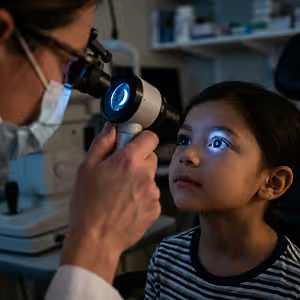
A pediatric eye exam at Lotus Eyecare tests all of it. Dr. Malani evaluates how the two eyes align and coordinate, how the focusing system responds under demand, and whether the retina and optic nerve are structurally healthy. When dilation is needed for a more complete view of the retina or to accurately measure refraction in a young child, it is performed and explained in advance.
What Dr. Malani evaluates at every pediatric visit
- Refractive error: myopia, hyperopia, and astigmatism
- Amblyopia (lazy eye) and reduced acuity in one eye that the other may be masking
- Strabismus and any eye turn that disrupts depth perception
- Convergence, tracking, and binocular coordination that affect reading endurance
- Retinal and optic nerve health through dilated or imaging-assisted examination
- Color vision, because it affects classroom and sports performance in ways parents may not realize
- Eye pressure when age and clinical picture make it appropriate
- Digital eye strain patterns and screen-use habits that may be driving symptoms
What a pediatric exam at Lotus Eyecare includes
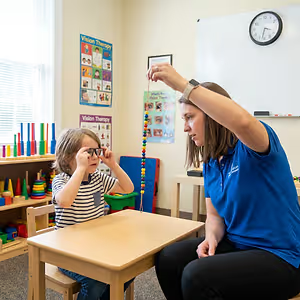
Dr. Malani begins with a developmental screening to confirm that visual milestones are tracking appropriately for your child's age. Testing then moves through binocular vision: how the two eyes align, how they converge at near distance, how the focusing system responds under demand, and whether the eyes track smoothly across a line of text. These are the tests that identify problems a letter chart cannot see.
Refractive error, eye health, color vision, and screen habits are assessed in the same visit. Every finding is explained in plain language before you leave. You walk out knowing exactly where your child's vision stands, whether glasses are needed, whether myopia management is worth discussing, or whether the next annual exam is all that is required.
Developmental vision screening
Dr. Malani checks that visual processing, near-point convergence, eye contact tracking, and focusing endurance are all developing on schedule. Children whose visual skills lag their age-level expectations often show up as struggling readers or kids who seem inattentive in class, not as kids with obvious eye problems. Identifying a visual skill deficit early means treatment while the visual system is still highly responsive, not after years of compensating for a problem that should have been caught sooner.
Exam pacing matched to your child
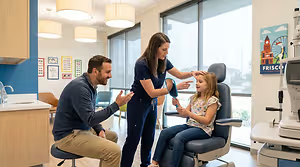
The testing is adapted to what your child can reliably do at their age and developmental level. Younger children are not asked to perform tasks designed for adults. Dr. Malani explains every finding in terms that are straightforward for both you and your child to understand. If a referral or follow-up action is needed, you hear it directly and you hear the reasoning behind it before you leave the office.
Related services for kids at Lotus Eyecare

If your child's prescription keeps climbing, we can slow it with Ortho-K, MiSight, or atropine.

Pediatric eye exam questions from Frisco parents
Dr. Malani sees children starting at age 5. A first exam before kindergarten establishes a baseline before the full demand of reading and near work begins. If a Frisco ISD screening flags a concern at any age, bring your child in promptly regardless of what the screening showed. The testing at our office is adapted to what your child can do, not what a standardized chart test requires.
Once a year for school-aged children. Vision changes quickly during growth years, and a yearly exam catches a worsening prescription, newly developing myopia, or binocular vision problems before they affect academic performance or comfort. Children already wearing glasses or contact lenses need annual exams to keep the correction current.
Yes. School screenings test distance acuity from a fixed chart and routinely miss focusing problems, eye teaming deficits, tracking difficulties, and any structural eye condition that does not reduce distance sharpness. Many children who pass the school chart still struggle with near work. A clinical exam is the only evaluation that checks all of those systems together.
Sometimes. Dr. Malani dilates when a more complete view of the retina is needed or when accurate measurement of refraction in a young child requires cycloplegia to relax the focusing muscles. When dilation is planned, you will know before the visit so you can arrange for light sensitivity afterward. It is not performed at every visit.
Our optical at Lotus Eyecare carries frames built for children, designed to handle sports, daily wear, and the physical demands of active kids in Frisco. Dr. Malani selects polycarbonate lenses for their impact resistance. We size the frame correctly, verify the optical centers align with your child's pupils, and walk through care so the glasses last through the school year.
Knowing exactly where your child's vision stands is worth one annual visit.
Most childhood vision problems are significantly easier to manage when detected before they become entrenched. Book a pediatric eye exam at Lotus Eyecare in Frisco and leave with a clear picture of your child's visual health.