
Keratoconus causes the cornea to thin and push outward into an irregular cone shape. As the cornea distorts, light no longer focuses cleanly on the retina, and the blurring and ghosting that result cannot be corrected with glasses alone. At Lotus Eyecare in Frisco, Dr. Malani fits custom scleral and hybrid lenses that restore clear vision for moderate and advanced keratoconus cases, and monitors early-stage disease to slow its progression.
Keratoconus Treatment in Frisco, Texas

What keratoconus does to your vision
A healthy cornea is evenly curved, like a smooth dome. In keratoconus, collagen fibers in one area of the cornea weaken, the tissue thins, and that area bulges forward. The resulting irregular shape means that light rays entering the eye strike the retina at multiple focal points rather than one, producing blurred, streaked, and distorted vision that worsens over time.
Glasses can compensate for simple refractive error but cannot correct the irregular aberrations from a misshapen cornea. This is why many keratoconus patients end up with fluctuating vision that keeps changing even with new glasses every year. The condition typically begins in the teens or early twenties and progresses through the thirties, which is why early detection matters: intervention started earlier gives more options.
Signs that keratoconus may be present
- Frequent prescription changes from year to year
- Blurred or distorted vision that new glasses do not fix
- Streaking, ghosting, or halos around lights at night
- Increased sensitivity to bright light and glare
- Increasing astigmatism that does not stabilize
- A long history of rubbing the eyes
- A family member diagnosed with keratoconus
- Vision that worsens noticeably between annual exams
How Dr. Malani manages keratoconus at Lotus Eyecare
Treatment is matched to the stage of the disease. Early keratoconus may be managed with specialty soft or hybrid lenses that provide better optics than standard contacts. Moderate and advanced cases typically do best with custom scleral lenses, which vault over the cone entirely and project a smooth optical surface onto the irregular cornea. When topography shows the cornea is still actively changing, Dr. Malani discusses corneal cross-linking referral to halt that progression before more corneal tissue is lost.
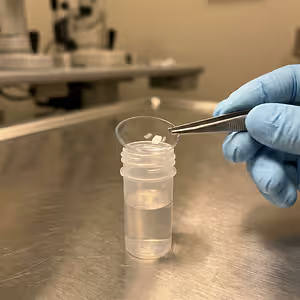
A scleral lens vaults entirely over the cone and rests on the stable white of the eye. The reservoir of saline underneath fills in the irregular contour of the cornea and creates a smooth refracting surface. For most moderate and advanced keratoconus patients, this is the lens design that finally returns consistent, all-day clear vision. Patients who were told they could not wear contacts often find that a properly fitted scleral lens changes that completely.
Co-management for corneal cross-linking
When topography confirms the cone is still progressing, corneal cross-linking can stop that change. The procedure uses riboflavin drops and ultraviolet light to strengthen the collagen bonds in the corneal stroma, which stabilizes the shape. Dr. Malani refers to trusted corneal specialists in the Dallas area for cross-linking and other surgical care, then manages the contact lens fitting and ongoing eye health here in Frisco.
What to expect at your first keratoconus consultation
Your first visit is a focused keratoconus evaluation. Dr. Malani maps the cornea with topography to assess the cone's shape, location, and degree of irregularity, then measures the pattern of thinning and determines whether the disease is progressing or stable. You leave with a clear picture of the stage you are in, an honest assessment of whether cross-linking is worth considering, and a lens plan designed to restore the vision quality you have been missing. There is no generic protocol here. The plan is built around your cornea.

Related specialty care


Patients told they cannot wear contacts often can, with the right lens.
Book a keratoconus consultation at Lotus Eyecare in Frisco and leave with a plan that fits the stage you are in.
Questions Frisco keratoconus patients ask us
Early on, yes, but only up to a point. As the cone becomes more pronounced, glasses can no longer compensate for the irregular aberrations. Specialty lenses, particularly custom scleral lenses, become the most reliable path to clear, comfortable vision for moderate and advanced cases.
It depends on the stage and your age. Most keratoconus progresses through the teens and twenties, then stabilizes by the mid-thirties. Corneal cross-linking can halt active progression in many cases. Dr. Malani reviews your topography at each visit and will tell you directly whether your measurements show active change or stable disease.
Cross-linking is a procedure that uses riboflavin eye drops combined with carefully dosed ultraviolet light to strengthen the collagen bonds within the corneal stroma. Strengthening those bonds stops the cornea from continuing to thin and bulge. It is most appropriate when topography shows the cornea is still actively changing. We refer to corneal specialists in the Dallas area for the procedure and coordinate all pre- and post-operative lens care here at Lotus Eyecare.
The first evaluation visit is typically about ninety minutes. Diagnostic scleral lenses are placed on the eye that same day to begin the fitting process. Custom lenses are ordered based on your corneal topography and arrive in one to two weeks. Most patients need two or three follow-up adjustments to finalize the fit. Specialty lens fittings are billed separately from a routine eye exam.
Avoid it. Repeated, forceful eye rubbing is associated with keratoconus progression and with a higher risk of progression after cross-linking. If itching or irritation is driving the habit, treating the underlying cause, whether allergies, dry eye, or eyelid inflammation, protects the cornea far better than managing the symptom.